
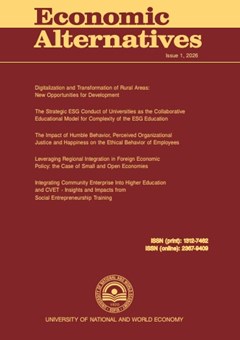
Current Issue
Volume
32
year
2026
Issue
1

Archive

AUTHOR'S GUIDELINES

ABSTRACT GUIDELINES

SUBMIT AN ARTICLE

SCIENTIFIC AND RESEARCH PROFILE

PUBLICATION ETHICS

PEER REVIEW POLICY

ABSTRACTING AND INDEXING

EDITORIAL BOARD

INTERNATIONAL EDITORIAL BOARD

PUBLISHER


Economic Alternatives articles are published open access under a Creative Commons CC BY 4.0 user licence

ADDRESS OF THE EDITORIAL OFFICE

ISSN (print): 1312-7462
ISSN (online): 2367-9409
4 issues per year

The authors' statements reflect their personal opinions and do not involve the editors of the journal.

The Editorial Board is committed to open science and free access to scientific publications. No Article Processing Charges apply.

The Publisher provides instant free access to the work and permits any user to read, download, copy, distribute, print, search, or link to the full texts of articles, crawl them for indexing, pass them as data to software, or use them for any other lawful purpose. All submitted manuscripts will be checked for plagiarism.

Typeset by:

Academic Publishing House of UNWE 

Printed by:

UNWE Printing House


0.9
2024CiteScore
 
29th percentile
Powered by  Scopus
Leveraging Regional Integration in Foreign Economic Policy: the Case of Small and Open Economies Economic Alternatives
year
2026
Issue
1

Leveraging Regional Integration in Foreign Economic Policy: the Case of Small and Open Economies

Abstract

The global economic landscape has undergone dynamic transformations, leading to an interconnected and interdependent system. This evolution has prompted governments, particularly those of small and open economies, to adopt innovative instruments to bolster their competitiveness. The article explores the growing trend of utilizing participation in regional integration as a strategic tool in active foreign trade policy analysing the specific challenges and opportunities for small and open economies. For them, integration might serve as a multifaceted foreign trade policy instrument, offering avenues to reduce vulnerability to external shocks, enhance competitiveness, preserve added value, and strengthen regional resilience. This proactive approach reflects an acknowledgment that participation in integration processes is a strategic means of advancing their interests and safeguarding their economies in an increasingly interconnected world. The proposed three-dimensional evaluation framework offers a nuanced analysis of integration processes, considering factors such as genesis, motivation, and development. This comprehensive approach provides valuable insights for policymakers, scholars, and analysts navigating the complexities of the contemporary international economic order.

Keywords

national competitiveness, Regional integration, Foreign economic policy, Small economies, Open economies
Download EA.2026.1.04.pdf