
Current Issue
Volume
32
year
2026
Issue
1

Archive

AUTHOR'S GUIDELINES

ABSTRACT GUIDELINES

SUBMIT AN ARTICLE

SCIENTIFIC AND RESEARCH PROFILE

PUBLICATION ETHICS

PEER REVIEW POLICY

ABSTRACTING AND INDEXING

EDITORIAL BOARD

INTERNATIONAL EDITORIAL BOARD

PUBLISHER


Economic Alternatives articles are published open access under a Creative Commons CC BY 4.0 user licence

ADDRESS OF THE EDITORIAL OFFICE

ISSN (print): 1312-7462
ISSN (online): 2367-9409
4 issues per year

The authors' statements reflect their personal opinions and do not involve the editors of the journal.

The Editorial Board is committed to open science and free access to scientific publications. No Article Processing Charges apply.

The Publisher provides instant free access to the work and permits any user to read, download, copy, distribute, print, search, or link to the full texts of articles, crawl them for indexing, pass them as data to software, or use them for any other lawful purpose. All submitted manuscripts will be checked for plagiarism.

Typeset by:

Academic Publishing House of UNWE 

Printed by:

UNWE Printing House


0.9
2024CiteScore
 
29th percentile
Powered by  Scopus
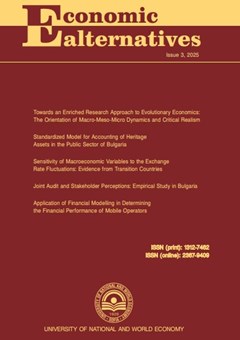
Towards an Enriched Research Approach to Evolutionary Economics: The Orientation of Macro-Meso-Micro Dynamics and Critical Realism Economic Alternatives
year
2025
Issue
3

Towards an Enriched Research Approach to Evolutionary Economics: The Orientation of Macro-Meso-Micro Dynamics and Critical Realism

Abstract

This paper examines the theoretical roots and methodological underpinnings of evolutionary economics, proposing a direction to enrich its research methodology. It contends that the field’s core is built on a tripartite analysis of innovation dynamics, biological interpretations, and institutional transformations. By integrating this dialectical perspective with the macro-meso-micro framework and critical realism, a solid methodological foundation can be established for more comprehensive investigations in evolutionary economics research. The paper concludes by emphasizing the need for practical application within the field, highlighting the importance of operationalizing these aspects to improve the analytical and interpretive capabilities of existing pertinent methodologies

Download EA.2025.3.01.pdf