
Current Issue
Volume
32
year
2026
Issue
1

Archive

AUTHOR'S GUIDELINES

ABSTRACT GUIDELINES

SUBMIT AN ARTICLE

SCIENTIFIC AND RESEARCH PROFILE

PUBLICATION ETHICS

PEER REVIEW POLICY

ABSTRACTING AND INDEXING

EDITORIAL BOARD

INTERNATIONAL EDITORIAL BOARD

PUBLISHER


Economic Alternatives articles are published open access under a Creative Commons CC BY 4.0 user licence

ADDRESS OF THE EDITORIAL OFFICE

ISSN (print): 1312-7462
ISSN (online): 2367-9409
4 issues per year

The authors' statements reflect their personal opinions and do not involve the editors of the journal.

The Editorial Board is committed to open science and free access to scientific publications. No Article Processing Charges apply.

The Publisher provides instant free access to the work and permits any user to read, download, copy, distribute, print, search, or link to the full texts of articles, crawl them for indexing, pass them as data to software, or use them for any other lawful purpose. All submitted manuscripts will be checked for plagiarism.

Typeset by:

Academic Publishing House of UNWE 

Printed by:

UNWE Printing House


0.9
2024CiteScore
 
29th percentile
Powered by  Scopus
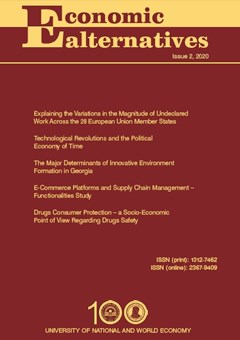
E-Commerce Platforms and Supply Chain Management – Functionalities Study Economic Alternatives
year
2020
Issue
2

E-Commerce Platforms and Supply Chain Management – Functionalities Study

Abstract

The rise of e-commerce worldwide represents an indisputable and sustainable process of transformation of previously known market relationships. It has led to the development and continuous improvement of a number of processes related to the efficient management of material flows in the supply chain. E-commerce platforms can in general be considered as specialised software solutions that, in addition to presenting products in digital space, can play a significant role in organising logistics, marketing and financial processes. This complex logistics management problem can be studied through several indicators related to integration of the inner supply chain and to the management of relationships with product suppliers, buyers and trade partners, and logistics services providers. The article outlines the results of a study of the logistics functionalities of some leading e-commerce platforms and reveals some trends in their evolution and their readiness for supporting some of the supply chain management processes.

Keywords

logistics, SCM, e-commerce
Download EA.2020.2.04.pdf